In an industry defined by constant innovation, some technologies earn a reputation that extends well beyond their original introduction. Alaris mWave’s line of Gabriel and Mark grid antenna platforms are a strong example of engineering that continues to deliver value - combining proven RF performance, rugged construction, and decades of field experience. These products have been highly successful in commercial and industrial applications, but can be customized for defence and security purposes where reliability is critical.
While newer antenna technologies continue to evolve, there remains a strong demand for parabolic grid antennas because many customers prioritize reliability, durability, and mission assurance above all else. A proven design that has supported critical communications for years often remains the right solution for today’s demanding applications.
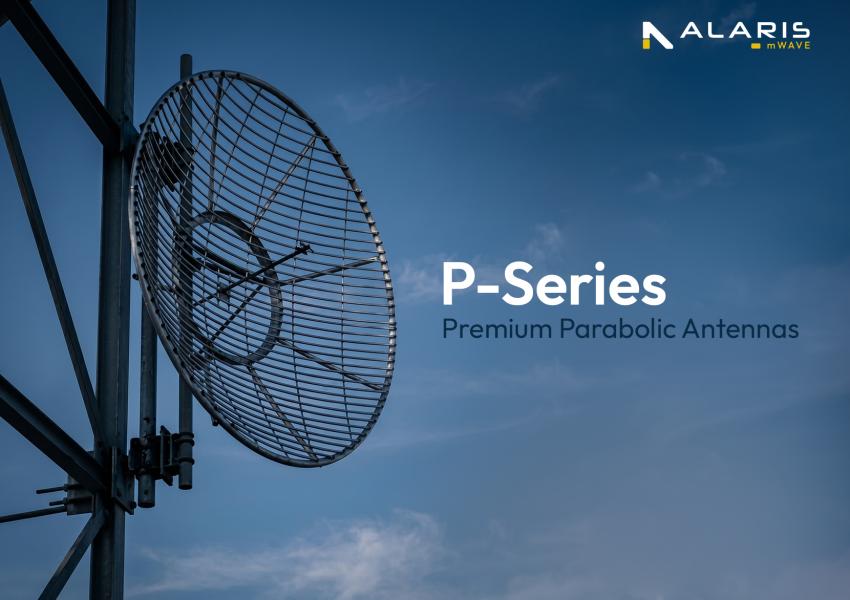
Alaris mWave’s P-Series Parabolic Grid Antennas represent this philosophy. Designed for robust performance across a wide range of communication and surveillance applications, the P-Series family continues to support customers requiring dependable RF solutions for applications including RF testing, spectrum monitoring, signal intelligence, direction finding, electronic support measures, broadcast, and wireless backhaul.
The continued success of parabolic grid antenna technology comes from several practical advantages. The open-grid reflector design provides a lightweight structure that can significantly reduce wind loading compared with similarly sized solid reflector antennas, helping simplify tower and mounting requirements. Alaris mWave’s P-Series designs are engineered for harsh operating environments, with configurations capable of surviving severe weather conditions while maintaining reliable performance.
Available in a wide range of sizes and configurations, the P-Series family supports reflector diameters from approximately 0.9 meters to 4.5 meters and frequency coverage from 216 MHz to 2.7 GHz, depending on model selection. Customers can also tailor solutions with different feed configurations, connectors, polarization options, and mounting arrangements to meet specific system requirements.
For many users, replacing a legacy antenna is not simply a matter of selecting the newest available technology. Existing systems often represent significant investments in infrastructure, integration, testing, and operational experience. Maintaining compatibility with proven equipment can reduce risk and help extend the life of mission-critical networks.
This is where Alaris mWave’s expertise continues to provide value. Supporting established antenna platforms requires more than manufacturing capability — it requires an understanding of RF performance, customer applications, and the operational environments where these products are deployed.
The ongoing demand for Alaris mWave’s grid antennas reinforces an important lesson in engineering: technology does not become obsolete simply because something new exists. When a design continues to perform, remains maintainable, and meets mission requirements, it continues to have a place.
While grid reflectors are primarily used as an economical solution for commercial and industrial applications, Alaris mWave stands ready to custom design a grid-reflector system and feed for defence and security applications where a grid antenna is best suited, ensuring compliance with the most rigorous electrical, environmental, and reliability requirements.
At Alaris mWave, we are proud to support both emerging RF challenges and the trusted technologies that have helped customers stay connected for decades.
Legacy design. Modern support. Proven performance.